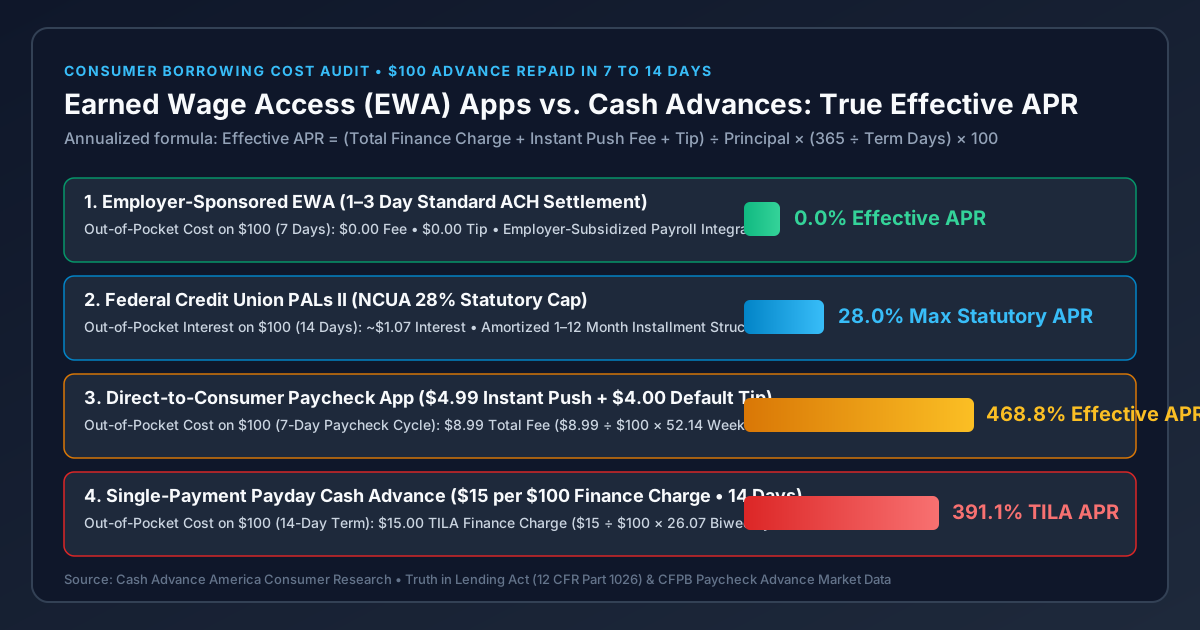
When an unexpected utility bill, medical copay, or auto repair arrives five days before payday, millions of American households turn to smartphone paycheck advance apps—marketed as Earned Wage Access (EWA) or "0% interest cash advances"—to bridge the gap. While accessing wages you have already earned sounds unequivocally safer than taking out a single-payment payday loan, consumer transaction audits conducted by the Consumer Financial Protection Bureau (CFPB) and state financial regulators reveal a critical catch: once you combine a $3.99 to $5.99 instant debit-card transfer fee, a $3.00 to $5.00 default "tip," and a $9.99 monthly membership subscription on a $100 seven-day advance, the annualized borrowing cost frequently exceeds 350% to 468% effective APR.
1. Employer-Sponsored EWA vs. Direct-to-Consumer (D2C) Cash Advance Apps
Not all paycheck advance services operate under the same legal structure, underwriting mechanics, or fee schedule. Before connecting your checking account to any mobile cash advance app, borrowers must distinguish between the two primary models in the market:
1.1 Employer-Partnered Earned Wage Access (Payroll-Integrated Model)
In a true employer-integrated EWA program (offered through workplace time-and-attendance platforms such as DailyPay, Payactiv, or ADP Wisely), the provider connects directly to your employer's verified timeclock ledger. When you complete an eight-hour shift, a percentage of your net accrued wages (typically 50% to 70% after estimated tax and benefit withholdings) becomes available for early transfer.
- Repayment Mechanism: Settled via direct payroll deduction on your scheduled payday before the remainder of your paycheck hits your bank account. Because settlement occurs at the payroll source, there is almost zero risk of triggering a checking account Non-Sufficient Funds (NSF) fee.
- Cost Structure: Standard 1-to-3 business day Automated Clearing House (ACH) transfers are frequently subsidized by the employer at $0.00 cost (0% APR), while instant Visa Direct or Mastercard Send push-to-debit transfers carry a flat convenience fee of $1.99 to $3.49.
1.2 Direct-to-Consumer (D2C) Cash Advance Apps (Bank-Account Scraping Model)
Direct-to-consumer apps (such as EarnIn, Dave, Brigit, MoneyLion Instacash, and Empower) have no contractual relationship with your employer. Instead, you grant the app read access to your primary checking account via an open-banking aggregator (Plaid, Finicity, or MX) and authorize an electronic debit from your account on your next predicted payday.
- Repayment Mechanism: Automated ACH debit or debit-card pull scheduled for the morning your paycheck typically clears. If your employer's payroll processor is delayed by a holiday, or if a utility auto-pay clears first, the app's automated pull can overdraw your checking account and trigger a $34 bank overdraft fee on top of the app's advance recovery.
- Cost Structure: Revenue is generated through three stacked fee layers: (1) monthly subscription dues ($1.00 to $14.99/month), (2) instant transfer fees ($2.99 to $8.99 per advance), and (3) pre-selected "voluntary tips" that require multiple taps through dark-pattern user interfaces to zero out.
2. The Exact Math: How a "0% Interest" App Reaches 468.8% Effective APR
Under the federal Truth in Lending Act (TILA), traditional lenders must express the total cost of credit as an Annual Percentage Rate (APR). Many D2C paycheck apps historically claimed exemption from TILA by arguing that instant transfer fees and tips are optional service charges rather than finance charges, and that advances are "non-recourse" (meaning they do not report defaults to Equifax, Experian, or TransUnion or sue borrowers in civil court).
However, from a household budget perspective, a dollar spent on an instant push fee and a pre-checked tip is identical to a dollar spent on loan interest. You can calculate the true annualized cost of any short-term advance using the standard consumer APR formula:
Effective APR Formula:
Effective APR = ((Instant Transfer Fee + Tip + Prorated Subscription Fee) ÷ Advance Principal) × (365 ÷ Days Until Payday) × 100
Consider a real-world example of a borrower who requests a $100 advance exactly 7 days before payday:
- Scenario A (Standard 3-Day ACH + $0 Tip): You wait 2 to 3 business days for standard ACH delivery and manually set the tip to $0.00. Total fee = $0.00 (0.0% Effective APR).
- Scenario B (Instant Debit Card Push Only): You need the funds immediately at the grocery register or auto shop and pay a $4.99 instant transfer fee with a $0.00 tip. Over a 7-day term,
($4.99 ÷ $100) × (365 ÷ 7) × 100equals 260.2% Effective APR. - Scenario C (Instant Debit Push + Default $4.00 Tip): You accept the app's pre-selected $4.00 tip alongside the $4.99 instant delivery fee, bringing out-of-pocket costs to $8.99 on a $100 advance. Over 7 days,
($8.99 ÷ $100) × (365 ÷ 7) × 100equals 468.8% Effective APR—higher than a standard 14-day storefront payday loan charging $15 per $100 (391.1% APR). - Scenario D (Repeat Biweekly Usage Trap): CFPB market monitoring shows that borrowers who use paycheck advance apps take an average of 24 to 36 advances per year. Paying $8.99 twice per paycheck cycle costs $467.48 per year in fees just to repeatedly borrow the same $100 of your own future paycheck.
3. Head-to-Head Comparison: EWA Apps vs. PALs vs. Cash Advances
The table below compares five short-term emergency liquidity options side by side for a $100 to $500 cash shortfall:
| Borrowing Option | Typical Advance Limit | Delivery Speed | Typical Out-of-Pocket Fee ($100 / 7–14 Days) | Effective APR Range | Credit Bureau Impact & Overdraft Risk |
|---|---|---|---|---|---|
| Employer-Sponsored EWA (Standard ACH) | $50 – $500 (50% of accrued shift wages) | 1–3 Business Days | $0.00 (Employer-subsidized) | 0.0% APR | No credit check; zero overdraft risk (deducted directly from gross/net payroll). |
| Federal Credit Union PALs I & II | $100 – $2,000 | Same Day – 24 Hours | ~$1.07 interest over 14 days (up to $20 max application fee) | 28.0% Max Cap (NCUA Rule) | Builds positive payment history; amortized over 1 to 12 months with no balloon debit. |
| D2C Paycheck Advance App (Instant + Tip) | $20 – $250 (new users); up to $750 max | Instant (Minutes via Visa/MC Push) | $3.99 – $8.99 ($4.99 instant fee + $4.00 tip) | 208% – 468.8%+ Effective APR | No soft/hard FICO pull, but automated payday bank pulls frequently trigger $34 bank NSF/overdraft fees. |
| Credit Card Cash Advance | 20% – 30% of available card limit | Instant at ATM | $5.00 or 5% upfront fee + ~29.99% daily accruing interest | 82% – 160% Effective APR (14 days) | No grace period; increases credit utilization ratio and impacts FICO score if balance carries over. |
| Single-Payment Payday Cash Advance | $100 – $1,000 (varies by state law) | Instant In-Store or Next-Day ACH | $15.00 – $20.00 per $100 borrowed | 391.1% – 521.4% TILA APR (14 days) | Full principal + fee due on next payday; unpaid balances may be sent to third-party collections. |
4. Federal and State Regulatory Crackdowns on Paycheck Advance Fee Traps
Because D2C cash advance apps grew into a multi-billion-dollar shadow credit market without standardized Truth in Lending disclosures, both the CFPB and state banking commissioners have enacted strict consumer protection rules:
- CFPB Truth in Lending Interpretive Guidance: Clarifies that paycheck advances where the consumer pays expedited delivery fees or solicited tips to access funds constitute consumer credit subject to TILA finance charge and APR disclosure mandates.
- California Department of Financial Protection and Innovation (DFPI) Rules: Requires income-based advance providers operating in California to register with the DFPI and report fee structures, tip solicitation rates, and repeat-borrowing metrics.
- Connecticut, Nevada, and Wisconsin Licensing & Rate Caps: Several state attorneys general and banking regulators treat combined expedited fees and tips as statutory finance charges subject to state small-loan interest caps.
5. 5 Actionable Safeguards Before Using Any Cash Advance App
If you need to use an Earned Wage Access app or short-term cash advance to cover an urgent household expense, follow this five-step checklist to protect your checking account from compounding fees:
Step 1: Always Select Standard 1–3 Day ACH and Manually Set the Tip to $0.00
If you know on Tuesday that rent or utilities are due on Friday, request the advance using the free 1-to-3 business day ACH option rather than paying $4.99 to $5.99 for instant debit-card delivery. Always tap "Custom Tip" or "Edit Tip" and enter $0.00 before confirming the transfer.
Step 2: Beware of the "Paycheck Hole" Repeat-Borrowing Cycle
Remember that an EWA advance is not extra income—it shrinks your next paycheck by the exact amount borrowed plus fees. If a $200 advance leaves your next Friday paycheck $208 short for groceries and gas, forcing you to immediately re-advance $200 the same morning, you are trapped in a synthetic rollover cycle. Instead of re-borrowing the full $200, step down your advance by $50 each pay period ($200 → $150 → $100 → $50 → $0) until your full paycheck is restored.
Step 3: Know Your Federal Right to Revoke ACH and Debit-Card Pulls
Even when a D2C cash advance app claims its advances are "non-recourse," it will still attempt to debit your bank account or Visa/Mastercard debit card on payday. If an automated pull would cause you to miss rent or incur a $34 bank overdraft fee, you have an absolute statutory right under the Electronic Fund Transfer Act (EFTA / Regulation E, 12 CFR § 1005.10) to revoke authorization and place a stop-payment order with your bank at least three business days before the scheduled transfer.
Step 4: Compare Multi-Month Installment Restructuring for Shortfalls Over $250
Single-paycheck advances—whether via an app or a storefront lender—force 100% principal repayment out of a single paycheck. Whenever an emergency expense exceeds 10% of your net biweekly take-home pay, compare personal installment loans or Credit Union PALs that spread repayment across 3 to 12 predictable monthly installments.
Step 5: Check Credit Union PALs II First (Immediate Eligibility Upon Membership)
Unlike PALs I (which required 30 days of credit union membership), Payday Alternative Loans II (PALs II) authorized by the National Credit Union Administration (NCUA) allow federal credit unions to issue $100 to $2,000 emergency loans on the exact day you open your membership account, capped by federal law at 28% maximum APR with zero prepayment penalties.